A plan for us · September 2026
Should we sell Datum?
Datum is the software we built to run our own jobs, trimmed down so another builder can install it on their own computer. Here's what it is, what it looks like, what it could earn, what it would take from us, and where it could go wrong.
02The short version
The short version.
What it is
Software that shows a builder what every job is worth, what's been spent, what's committed and what's left, with crews clocking in from their phones. It came out of the system we run Acewood on.
Why a builder would buy it
Software like this can cost a small builder hundreds of dollars a month, and much of it charges more as the crew grows. Datum is one payment, and the records stay on the builder's own computer.
What it would take from us
A few months of part-time work to finish phone access from job sites, a signed installer, legal terms and a checkout. About $5,650 before the first sale, about $6,450 a year to run after that, and support time as it sells.
What it could earn
At an example price of $1,490, about 5 sales pay back the start-up money. Over three years, profit before tax runs from $74,000 selling 1 to 3 a month to $687,000 selling 6 to 25 a month. Those sales speeds are guesses.
Today's decision: whether to do step 1 only. Finish Datum and test it with a few builders we know, with a spending cap and a checkpoint before we sell anything.
03The problem
We built it because our own jobs outgrew spreadsheets.
Acewood ran on a patchwork: a time-clock app, Excel workbooks, a task app and QuickBooks, with a lot of copying between them. Files went stale, formulas broke, and nobody could see where a job stood without digging.
"Is this job still making money?"
The answer was spread across invoices, supplier bills and timesheets, in different files.
"Did every hour make it onto the invoice?"
Hours travelled from a time-clock export to spreadsheets to the invoice, and crew notes had to be rewritten before a client could see them.
"What does it cost to add a person?"
Plenty of job software charges for every user. JobTread, for one, adds US$20 a month for each person, so the bill grows with the crew.
04What Datum is
Datum makes job money obvious.
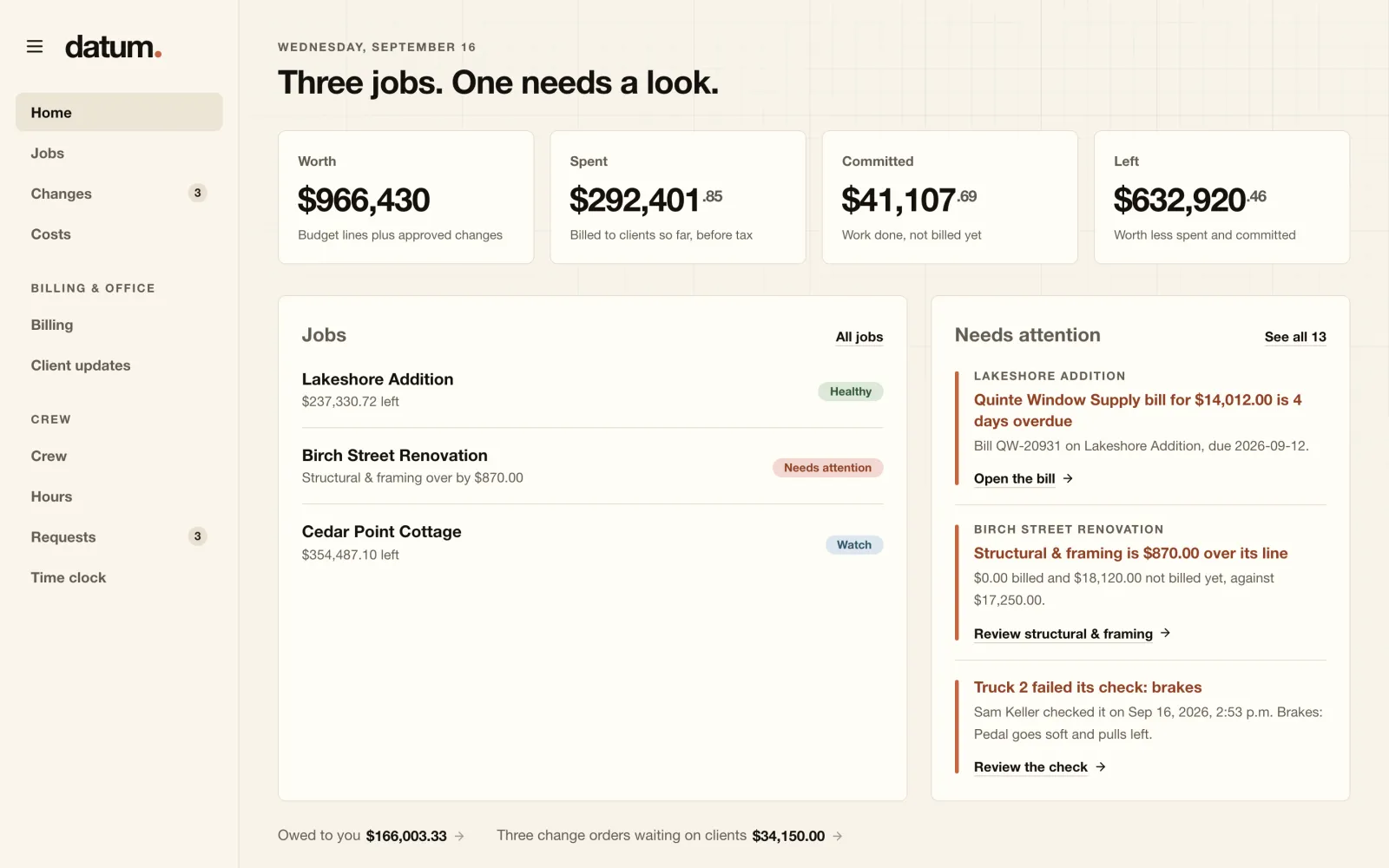
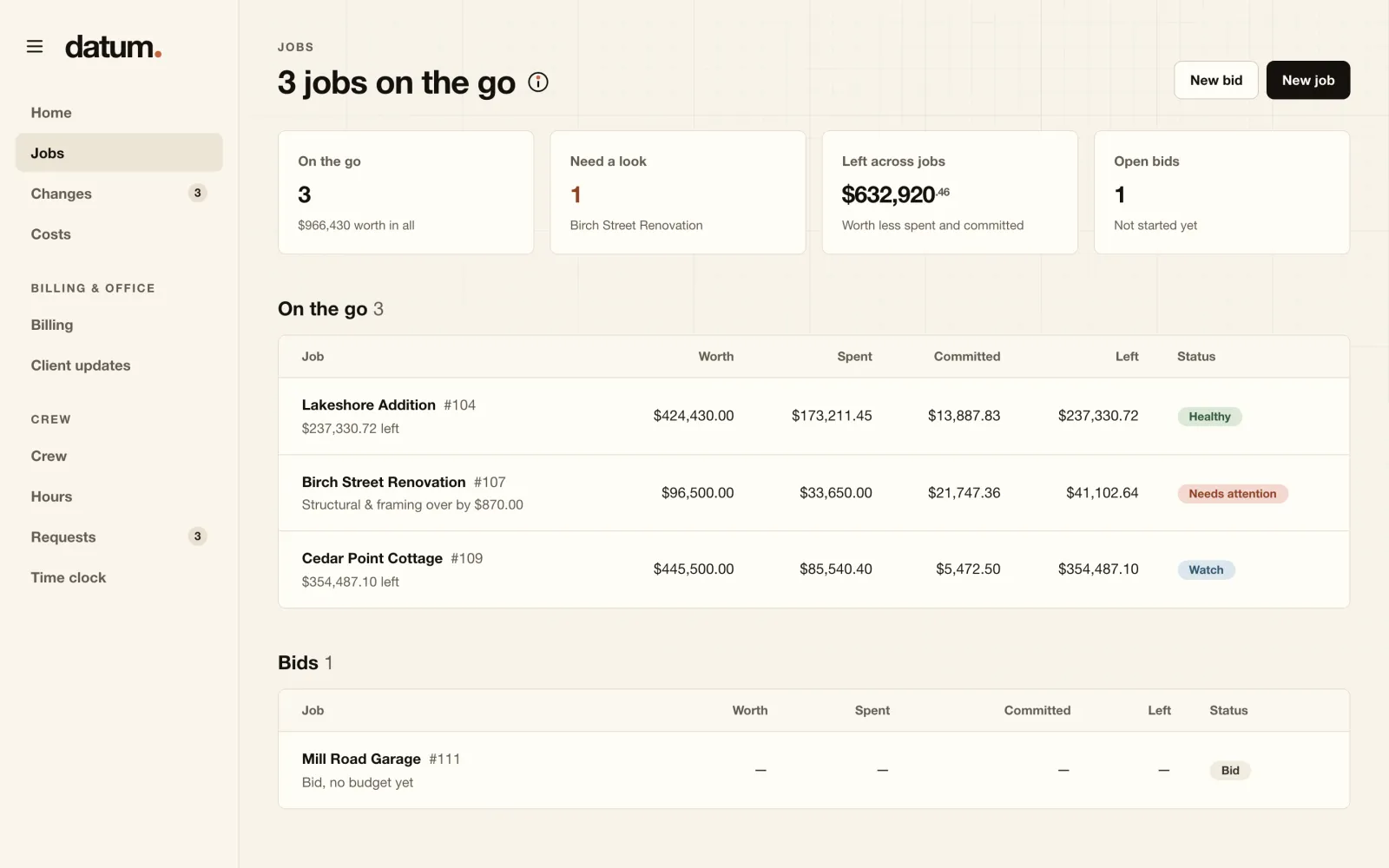
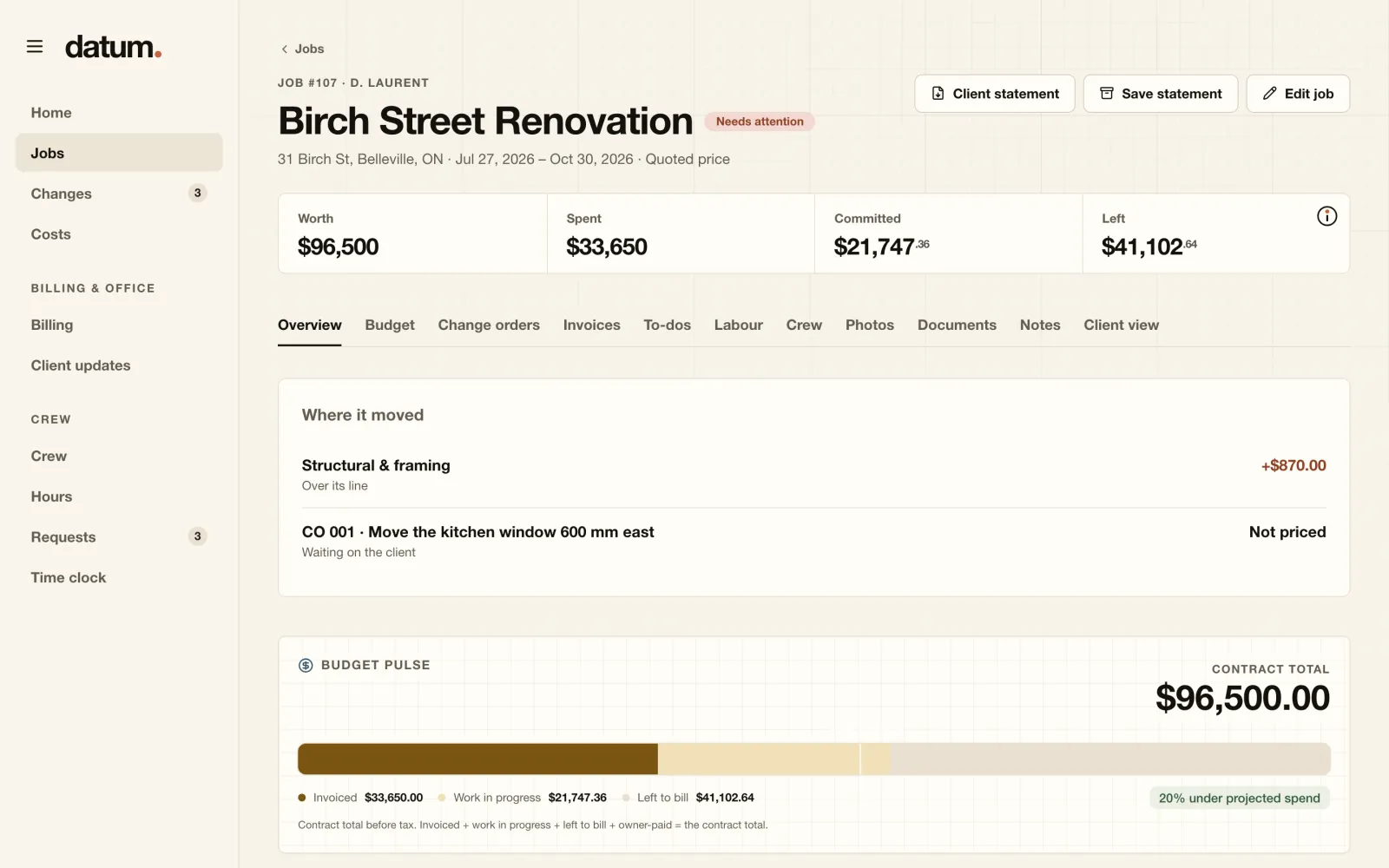
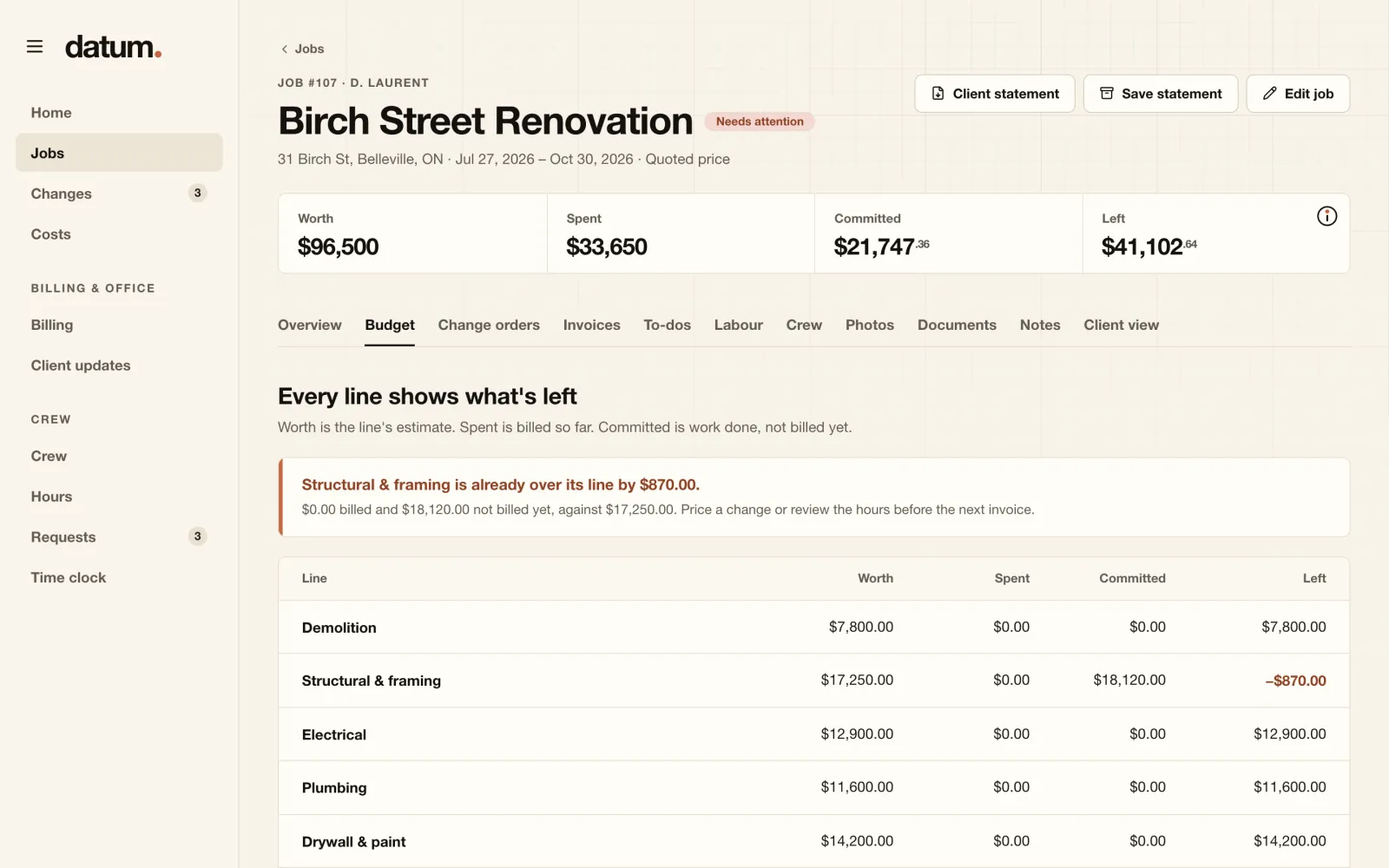
- See which job needs a look. Every job and every budget line shows what it's worth, what's spent, what's committed and what's left. Anything over budget, overdue or waiting lands on one list with the next step.
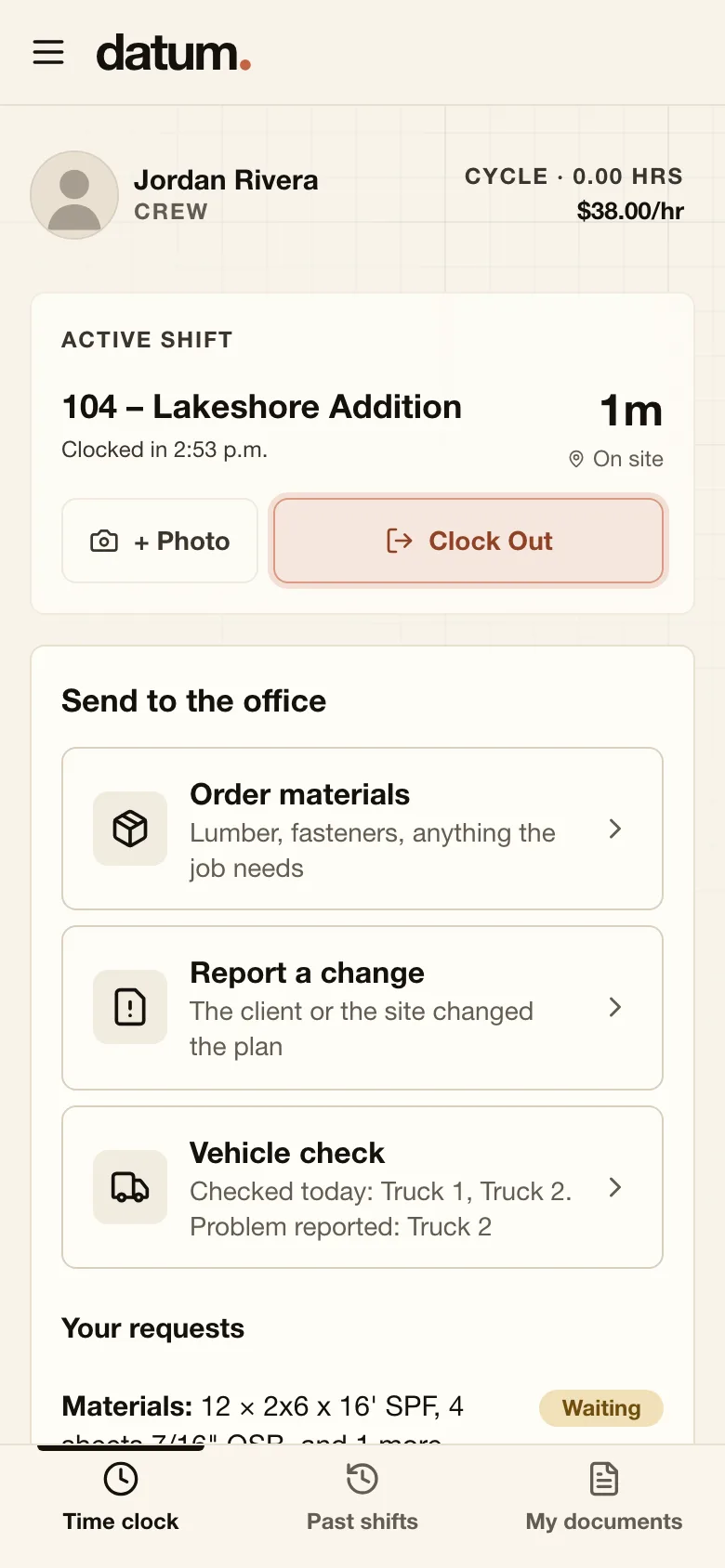
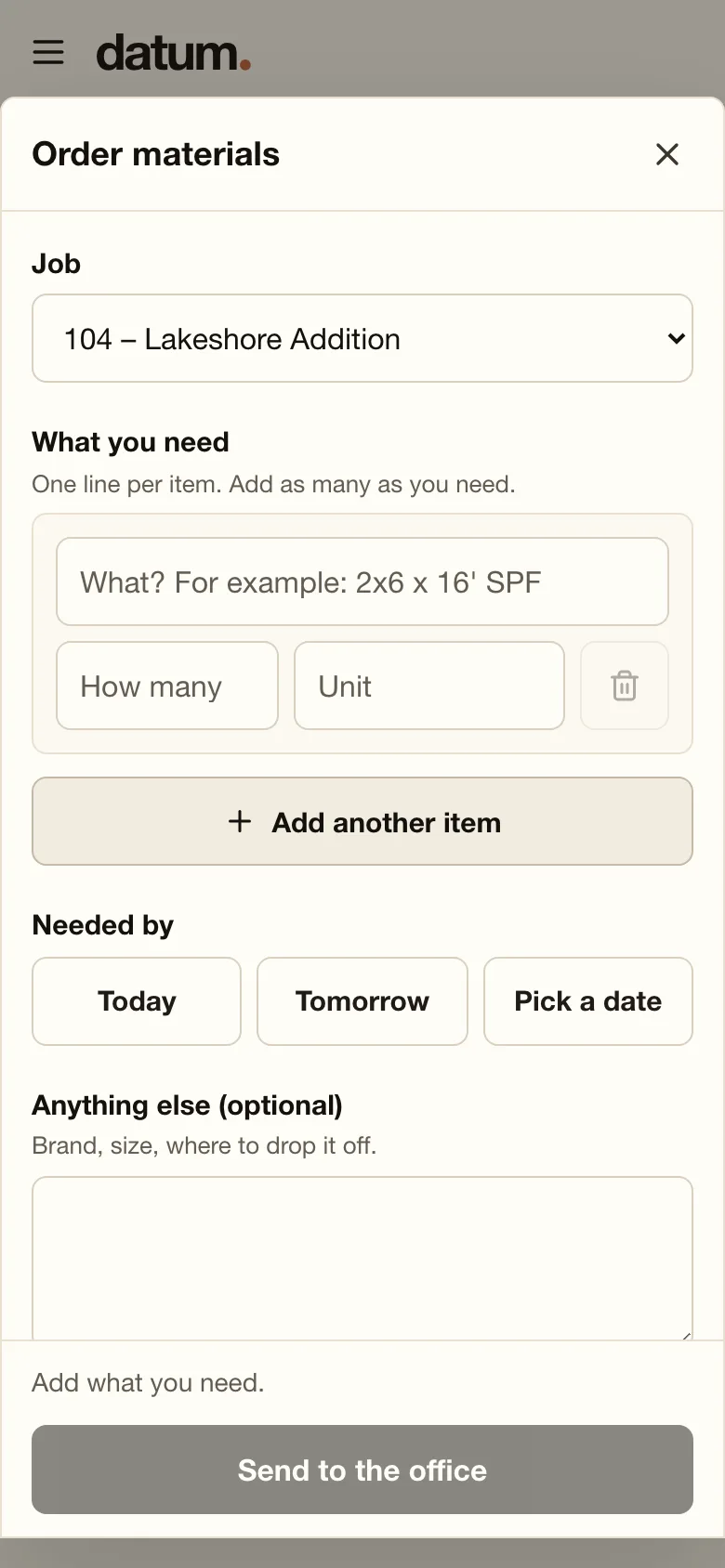
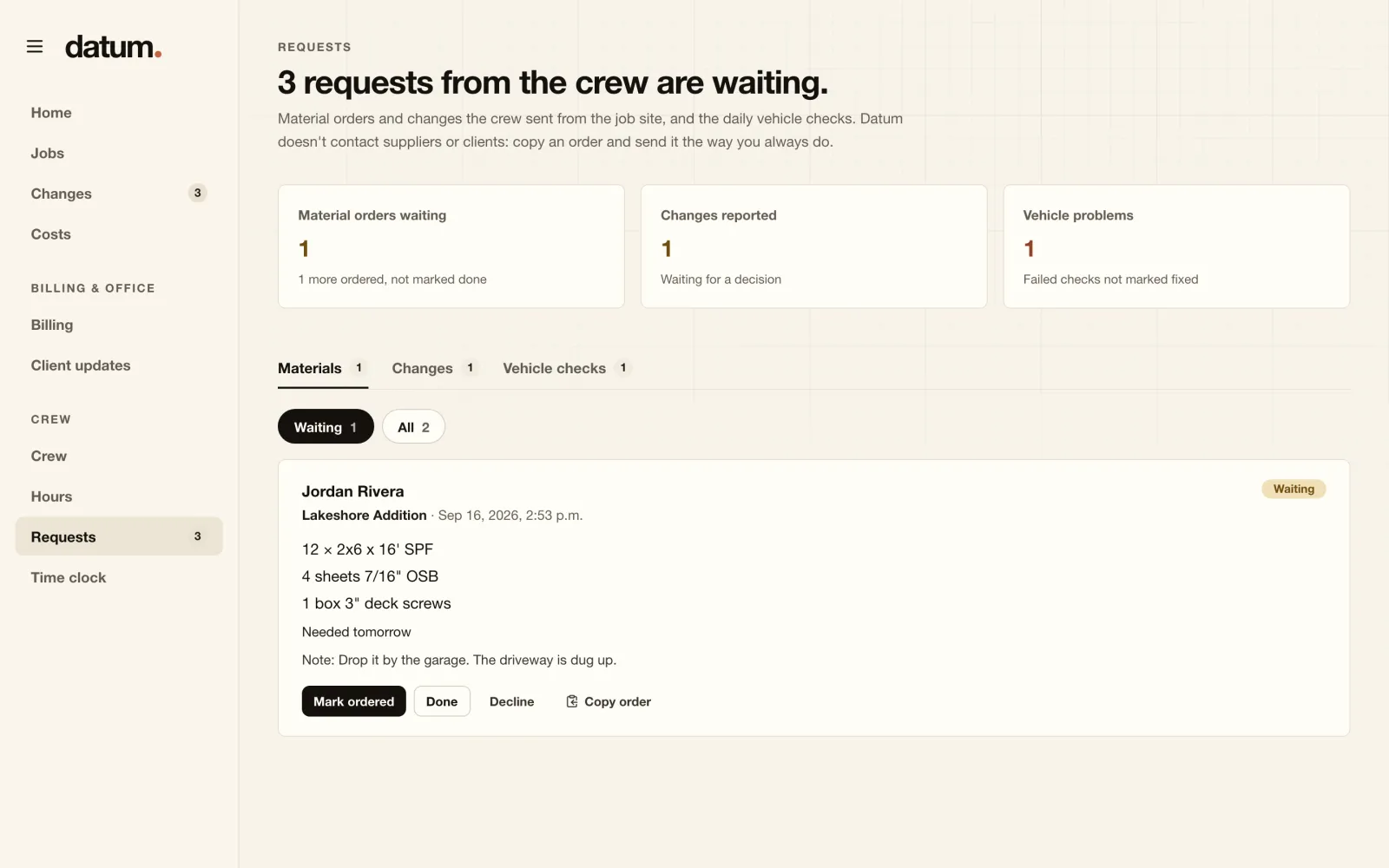
- Get hours from the phone to the invoice. Crews clock in, add notes and photos, and send material orders and changes from the site. The office turns that into payroll hours, invoices, change orders and client statements.
- Own it. One payment and as many logins as the company needs. It runs on a computer in the builder's office, backs itself up every night, and the office keeps working when the internet drops.
05What it looks like: the office
Open any job and the money is the first thing you see.
06What it looks like: the job site
The crew's phone sends the office what it needs.
07What it looks like: billing and paperwork
It checks the billing steps, then prints the paperwork with the builder's name on it.
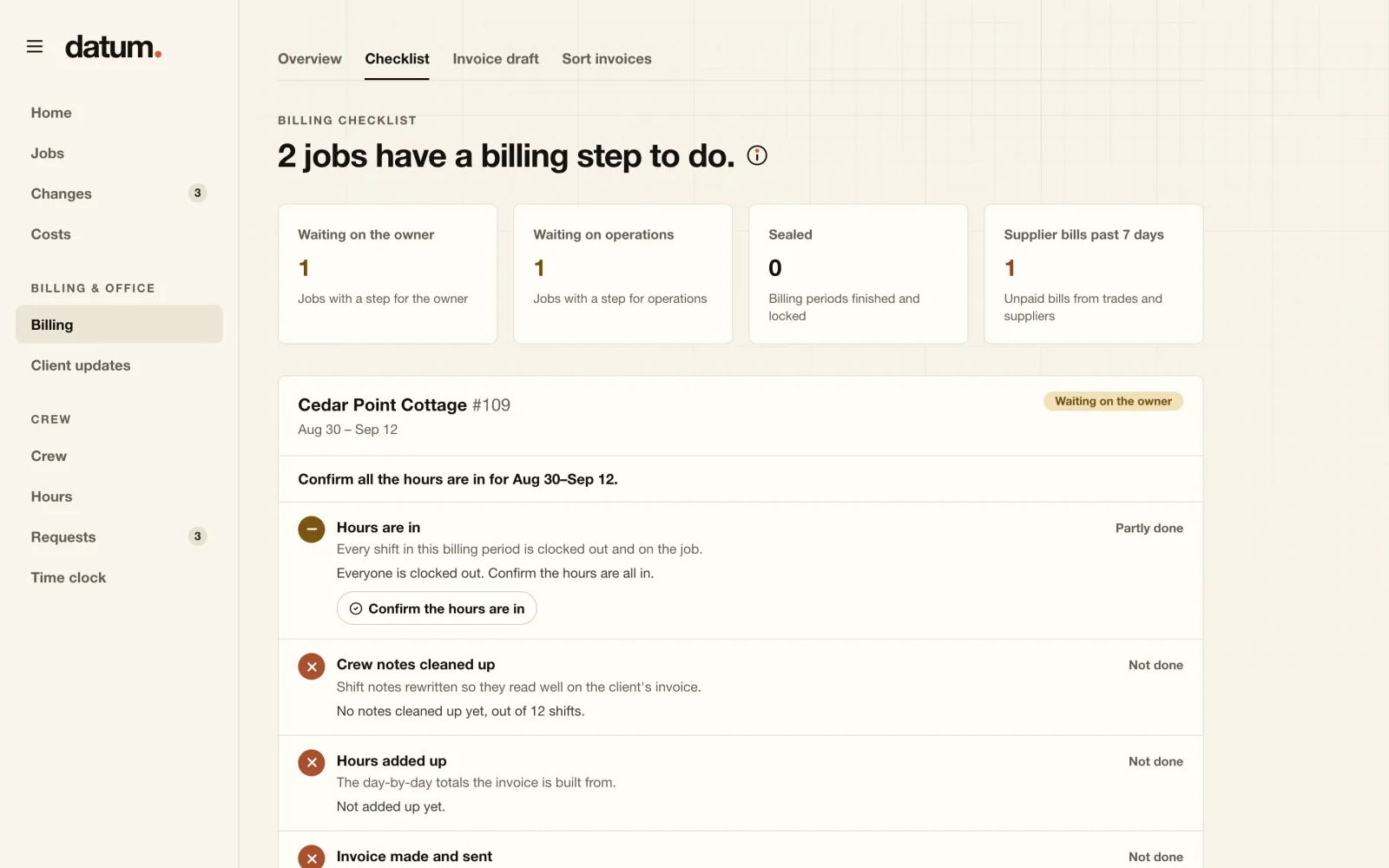
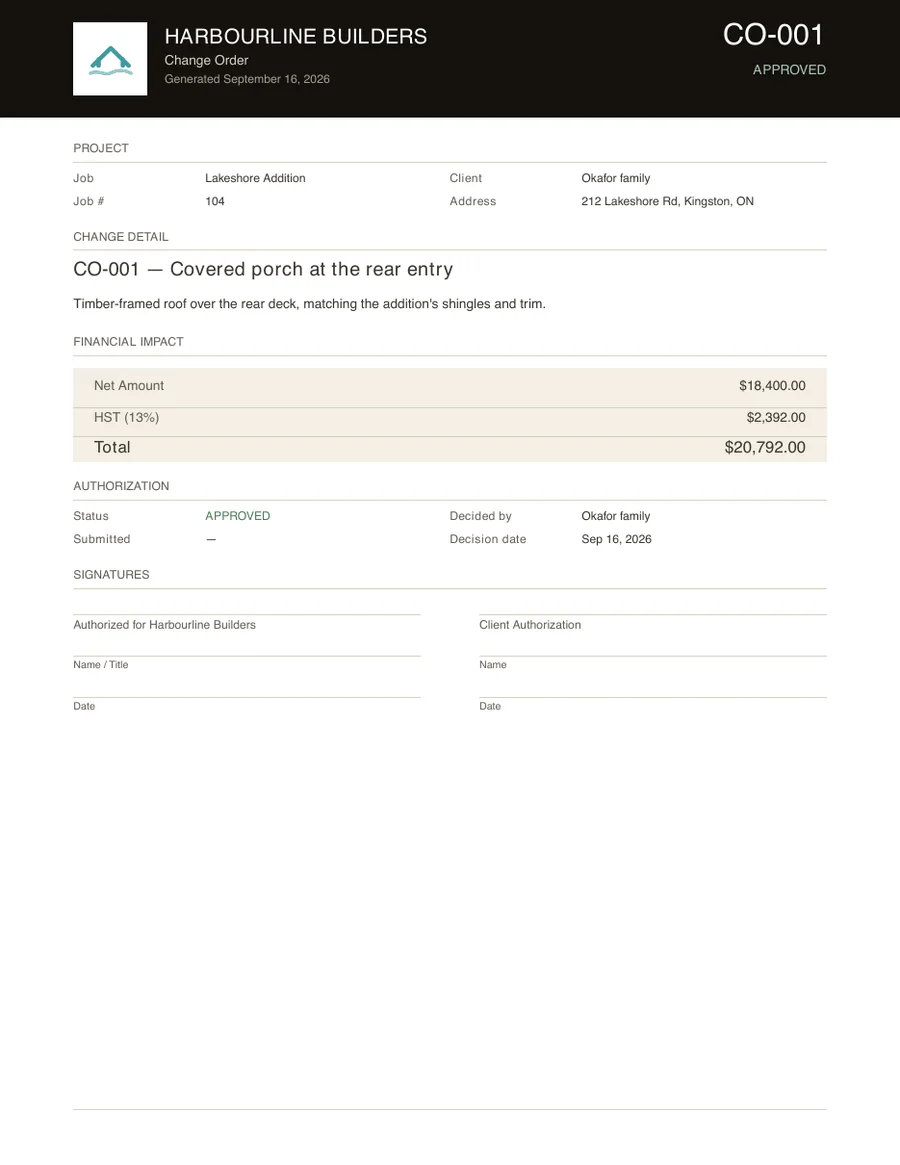
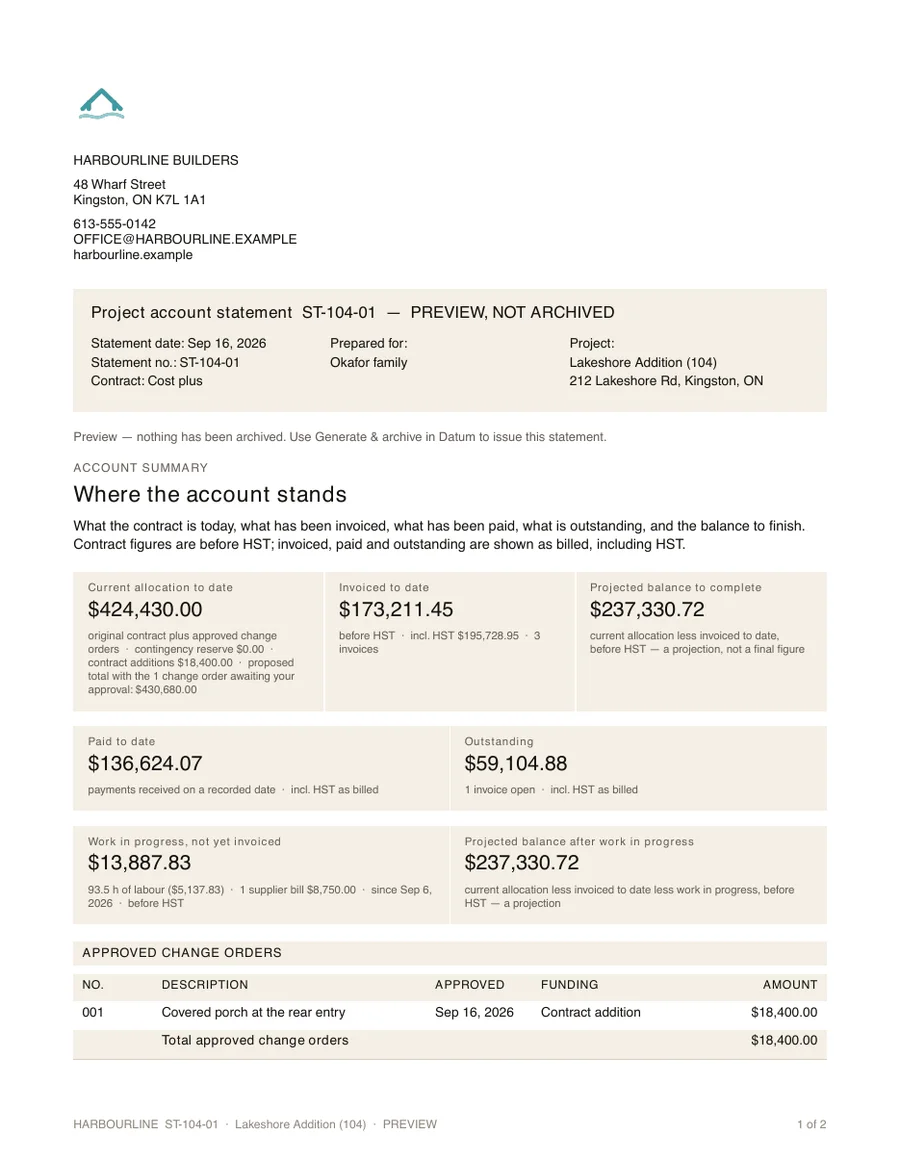
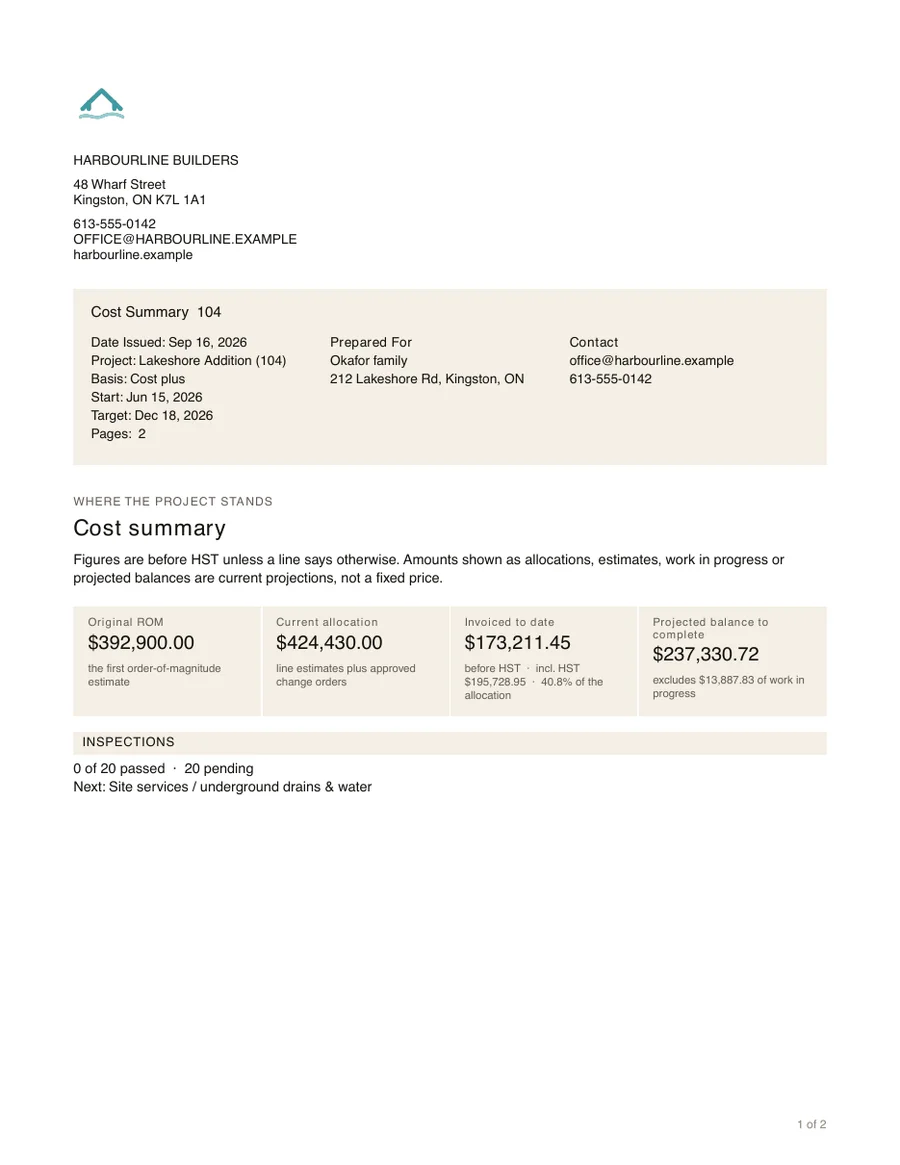
Datum drafts. The builder sends, from their own email, when they're ready. Nothing goes to a client on its own.
08Is it real?
It already runs a real company: ours.
Proven at Acewood
- Since May 2026 our crews have clocked in on the system Datum came from, instead of the time-clock app we used before.
- Our job budgets, change orders and the hours breakdowns behind our invoices live in it.
- Datum is that system with our records taken out. It installs empty, and each builder fills it with their own jobs.
Built and working today, on a Mac
| Jobs, budgets and the four numbers | Working |
| Crew phone clock with notes, photos, material orders, change reports and vehicle checks | Working |
| Payroll hours, billing checklist, invoices, change orders, client statements | Working |
| Nightly backups and PIN resets | Working |
| Crew phones from job sites, not just the office Wi-Fi | To build |
| Signed installer, legal terms, checkout, website address | To do |
| Windows version | Later |
09Why a builder would switch
Builders already pay every month for software like this. Datum is one payment.
What a 6-person builder pays over three years
Canadian dollars, before tax. Datum at the example prices from slide 12, including Datum Link.
| Software | How you pay | Published price |
|---|---|---|
| JobTread | US$199 a month, plus a fee for each extra user | US$2,870 a year6 users, yearly plan |
| Contractor Foreman | Yearly plans by number of users | US$1,997 a yearPlus plan, up to 8 users |
| Buildertrend | Monthly; third-party sites report plans by quote | US$339–1,099a month, as reported |
| Datum | Once, plus optional Datum Link | $1,490+ $99 a year for Link |
US prices converted at 1.3917, the Bank of Canada rate for September 15, 2026. Sources on the last slide.
10Who would buy it
Canada has 40,969 home builders and renovators with employees. We'd need a few hundred.
residential building businesses in Canada in 2025, counting one-person outfits. Renovators are included.
of them have employees. That's who Datum is for.
of those are in Ontario, where Datum's payroll and payment rules are set up first.
of the ones with employees have fewer than 5 people; 99.7% have fewer than 100.
Our target
Builders with fewer than 20 people doing $1 to 3 million a year. Statistics Canada groups businesses as 1–4 and 5–99 employees, so our target sits inside these counts but isn't counted on its own.
| After three years of selling | Builders | Share of Canada | Share of Ontario |
|---|
11How it makes money
One payment for Datum, and a small yearly fee for phones on job sites.
Datum
Pay once
Everything in the office, as many logins as the company needs. Example price $1,490. The price isn't decided.
Datum Link
Yearly, optional
Lets crew phones reach the office computer from any job site. Example price $99 a year, not decided. Our research puts our cost at about $4 to $9 a company a year. Similar remote-access services charge CA$87 a year (Nabu Casa) and US$60 a year (TrueNAS Connect Plus).
Datum Hub
Free, do-it-yourself
An idea we're weighing: a builder who already has their own web address connects crew phones through their own free Cloudflare account, and pays us nothing more.
Paddle runs the checkout. They charge 5% + US$0.50 a sale with no monthly fee, and they collect and send in the sales tax.
Our own taxes. A business has to register for GST/HST once taxable sales pass $30,000 over four quarters. Our accountant can tell us how selling through Paddle changes that for us.
12What it could earn
Pick a sales speed and see what's left after costs.
Nobody knows how fast it will sell, so these are what-ifs, not predictions. Profit is before income tax and doesn't count Ethan's time building it. The costs on the next slide feed these numbers.
| Sales | Money in | Money out | Profit | Support a week |
|---|
13What it takes: money
About $5,650 before the first sale, then about $6,450 a year to run.
| Published prices | Cost |
|---|---|
| Apple Developer ProgramSigns the Mac installer so it opens without warnings | US$99 a year≈ $138 |
| Paddle checkoutTakes payment and handles sales tax | 5% + US$0.50a sale |
| Windows code signingMicrosoft's Artifact Signing, once we sell a Windows version | US$9.99 a month≈ $167 a year |
| Datum Link serversFrom our phone-access research | About $10–19 a monthat 100 builders; up to $113 at 1,000 |
| Website address (.ca) | $15–20 a year |
| Website hosting | Free tier |
| Incorporating a separate companyIf we choose to; Angrove Law's flat fee | $750plus government fees |
| Our guesses, until we get quotes | Amount |
|---|---|
| Lawyer: licence terms, refund policy, privacyUS lawyers charge $500–1,500 for basic terms and privacy alone | once |
| Accountant | a year |
| Insurance for software mistakesTechnology errors and omissions; needs a quote | a year |
| MarketingOur choice, from the first sale | a month |
| Paid support helpOnly for hours past what we can do ourselves | an hour |
| Support we do ourselves before paying for help | a week |
Change any guess and every slide updates. We also assume 5% of sales get refunded.
14What it takes: work and time
A short list to finish before we sell. After that, most of the work is support.
-
Step 1 · Finish and test
A few months, part-time
- Crew phones from job sites: pair each phone with a code, warn when the office computer is off, and run a small Datum Link test.
- A signed Mac installer.
- Licence terms, refund policy and privacy page, reviewed by a lawyer.
- A few builders we know use it on real jobs, free.
-
Step 2 · Start selling
Mac, across Canada
- Pick the price. Set up the Paddle checkout, the website address and a support email.
- Help new builders get set up.
- Fix what the first builders find.
-
Step 3 · Grow, if it's working
Only once sales pay for it
- A Windows version.
- Datum Link for everyone, with yearly billing.
- A crew app in the App Store and Google Play.
Who does the work
Ethan, with Claude, an AI, doing most of the programming. That's how Datum was built. A lawyer, an accountant and an insurance broker for their parts.
Support time at the speed you picked
About 1 hour a week in year 1, 5 in year 2 and 11 in year 3, on top of building and fixing Datum.
15What could go wrong
What could go wrong, and how we'd keep it small.
It takes Ethan's time from Acewood and from home.
How we'd limit it: agree on weekly hours up front, keep Acewood first, and stop at a checkpoint if it doesn't fit.
Phones on job sites are the hardest part to get right.
How we'd limit it: test with a few builders before selling. Pairing phones with a code comes first, because a 4-digit PIN reachable from the internet could be guessed in under a day and a half.
Support grows with every sale.
How we'd limit it: a sample company to learn on and clear setup guides. Pay for help only once sales cover it; that cost is already in the numbers.
Mac only, at first.
How we'd limit it: sell to builders with a Mac in the office first, and add Windows once the Mac version is settled. Fewer buyers until then.
Selling software is new to us.
How we'd limit it: start with builders we know and word of mouth, spend small on marketing, and keep what works.
A mistake in the software costs a builder money.
How we'd limit it: licence terms written by a lawyer, insurance, a nightly backup, and records that are never deleted, only voided.
Selling once means income stops when sales stop.
How we'd limit it: Datum Link renews every year, so the builders we already have keep bringing in something.
Bigger companies could cut prices or copy the idea.
How we'd limit it: their business is built on monthly fees. Datum's pitch is the opposite: pay once, own it, keep your records.
16What we'd decide today
Say yes to step 1 only.
- MoneySpend up to $6,000 to finish Datum and test it with a few builders we know. Our estimate is $5,650.
- TimeAgree on how many hours a week Ethan puts in, and keep Acewood first.
- Before we sellThe test builders use it on real jobs, and their crews clock in from their job sites without trouble.
- Six months inKeep going if sales cover the costs and support fits in the hours we agreed. If not, we stop.
- Worst caseWe're out about $6,000 and our time. Acewood keeps its own system either way.
We decide together, and we can stop at any checkpoint.
17Sources and notes
Where the numbers come from.
- Builder counts, 2025, and size groups: Statistics Canada, published by Innovation, Science and Economic Development Canada, Residential building construction (NAICS 2361), businesses and summary, which defines the group as building, remodelling and renovating homes.
- JobTread: jobtread.com/pricing, US$199 a month plus US$20 a user, or US$16 a user with 20% off on a yearly plan.
- Contractor Foreman: contractorforeman.com/pricing, yearly plans from US$588 (1 user) to US$3,984 (unlimited).
- Buildertrend's own pricing page couldn't be checked; the range comes from third-party sites Costbench and buildertrendpricing.com.
- Paddle: paddle.com/pricing. Apple: developer.apple.com/programs/enroll. Microsoft: Artifact Signing pricing.
- Exchange rate: Bank of Canada, US$1 = CA$1.3917 on September 15, 2026.
- GST/HST: Canada Revenue Agency, when to register.
- Incorporation: Angrove Law. Terms and privacy costs: ContractsCounsel, US lawyers, US dollars. Domain: Ownr.
- Datum Link costs, the PIN-guessing figure and the Nabu Casa and TrueNAS prices: our own phone-access research, September 16, 2026.
- Guesses, all adjustable on slides 12 and 13: sales speeds, the example prices, Link take-up (50%) and renewals (85%), refunds (5%), support hours, lawyer, accountant, insurance, marketing and paid-help costs.
- Screens show an invented sample company. Every name and figure in them is made up.